From the “Ernest Solvay” station, set up in 1898 in the grounds of the Observatory in Uccle, to today’s national monitoring network: more than a century of instrumental seismology in Belgium.
- 1898First Belgian seismic station, in Uccle, funded by Ernest Solvay.
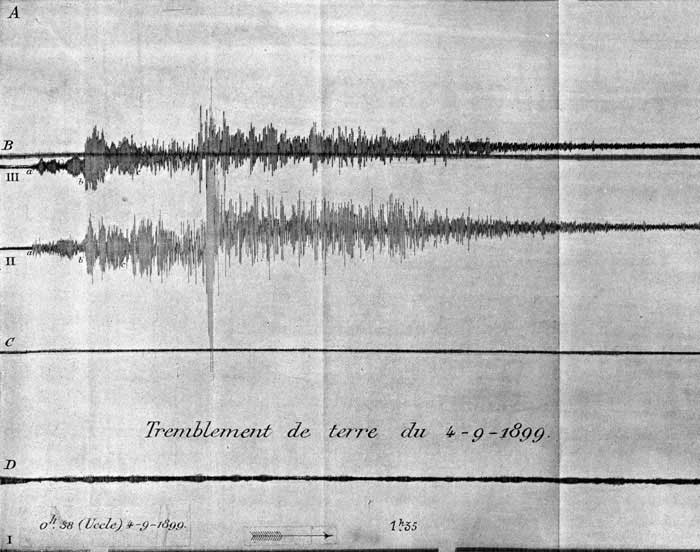
- 1899First earthquake recorded in Belgium, on 4 September: an earthquake in Alaska.
- 1904Ernest Solvay donates the geophysical cellar to the State.
- 1909The Wiechert pendulums enter service (1909 and 1910).
- 1911Galitzine pendulums: first electromagnetic recording.
- 1938Earthquake of 11 June near Oudenaarde, the largest recorded in Uccle before 1945.
- 1958Second Belgian station, in Dourbes (RMI).
- 1977Membach station, in a 130 m gallery.
- 1983Liège earthquake of 8 November: the network has only four stations.
- 1985Uccle enters the era of digital seismology.
- 1989The network has 15 stations, 6 of them linked to Uccle by telemetry.
- 1998Borehole seismometer at 140 m depth in Uccle.
- 1999Start of the accelerometric network.
- TodayMore than twenty stations, most of them linked to Uccle by telemetry.
The beginnings in Uccle (1898–1904)
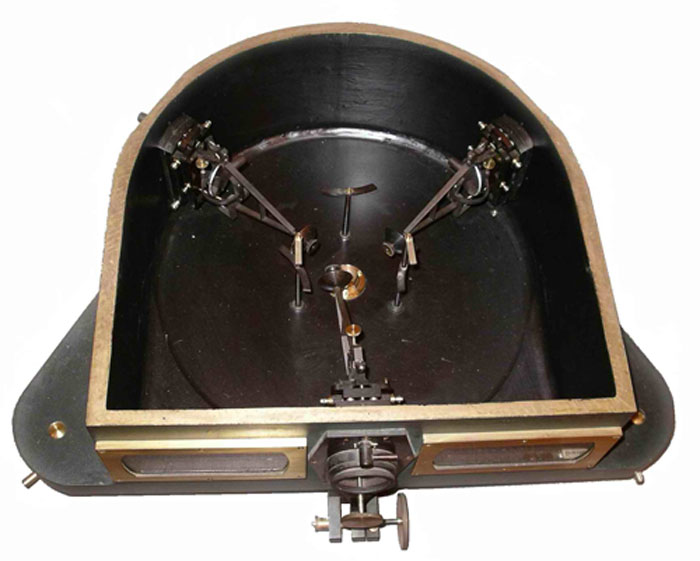
The first Belgian seismic station was set up in Uccle at the end of 1898, at the instigation of Eugène Lagrange, professor at the Royal Military Academy. The first seismometer was a von Rebeur-Ehlert triple horizontal pendulum (figure 1) with photographic recording. It recorded its first seismic movement on 4 September 1899 (figure 2). It was housed in the underground chamber built specially for seismic observations in the grounds of the Royal Observatory of Belgium, which had moved from central Brussels to Uccle in 1890.
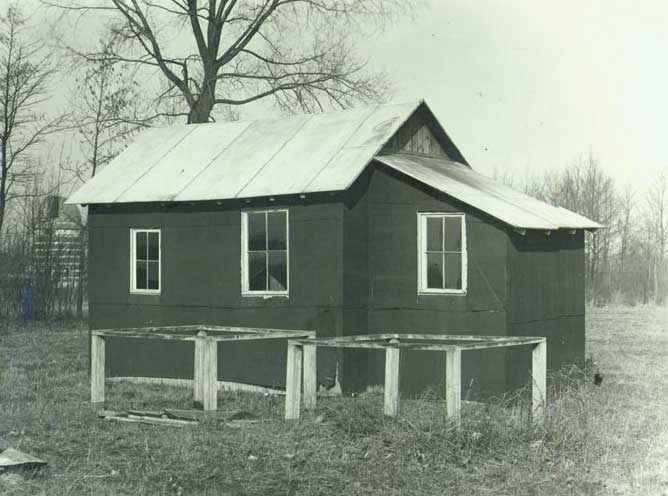
The Observatory was the obvious choice, as it was the only quiet place at the time where the time could be known accurately. Ernest Solvay, a great patron, financed the station entirely, which made it his private property. The monthly bulletins were officially entitled “Bulletin de la station géophysique d’Uccle (station Ernest Solvay)” (figure 3).
At the same time, E. Lagrange was delegated to the permanent seismological commission founded in 1899, which met in Strasbourg in April 1901. At that meeting he sat on the commission that was to decide on the status of the assembly. This led to the founding of the International Seismological Association, today’s IASPEI (International Association of Seismology and Physics of the Earth’s Interior).
On 1 January 1904, Ernest Solvay donated the geophysical cellar to the State, and it became part of the Observatory.
Early instruments (1906–1919)
In June 1906, two heavy horizontal “Bosch-Omori” seismometers were installed, built by Bosch like the von Rebeur-Ehlert triple pendulum. Recording was mechanical, with a stylus scratching smoke-blackened paper.
The triple pendulum was definitively decommissioned on 13 March 1909, and the heavy pendulums on 22 March 1911. In 1912, both Bosch pendulums were transferred to the Ministry of the Colonies and sent to Elisabethville, now Lubumbashi, in Congo.
In 1909, the 1000 kg horizontal Wiechert pendulum was put into service, followed in 1910 by the 1300 kg vertical Wiechert pendulum. Both instruments recorded ground motion with a stylus scratching smoke-blackened paper.
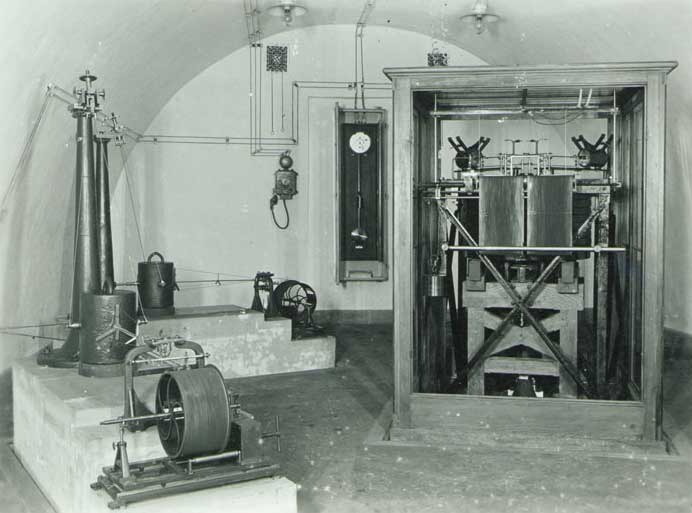
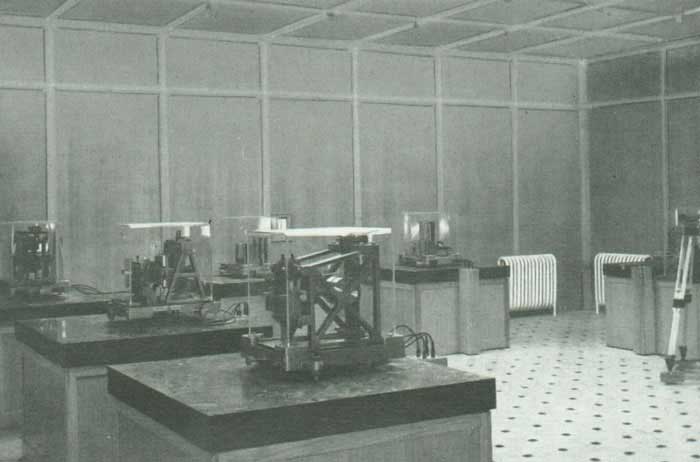
In 1911, the station was equipped with two horizontal Galitzine pendulums (figure 5), fitted with the first electromagnetic device designed to record earthquakes, the basis of all modern systems. During the First World War, for lack of photographic paper, only the mechanical recording of the Wiechert seismometers continued. The others resumed on 12 July 1919.
Between the wars and up to the 1970s
On 30 April 1930, a vertical Galitzine-Wilip seismometer completed the station. From 1910 to 1945, 9697 earthquakes were recorded in Uccle, around 80 of them local. The most important of these was the earthquake of 11 June 1938 near Oudenaarde.
Classical recording with the Galitzine and Wiechert seismometers continued until 1962. After that, ink recorders registered the three components of the Wiechert seismometers on paper rolls. This system, however, strongly altered the frequency response of the signals and was not suited to recording local earthquakes.
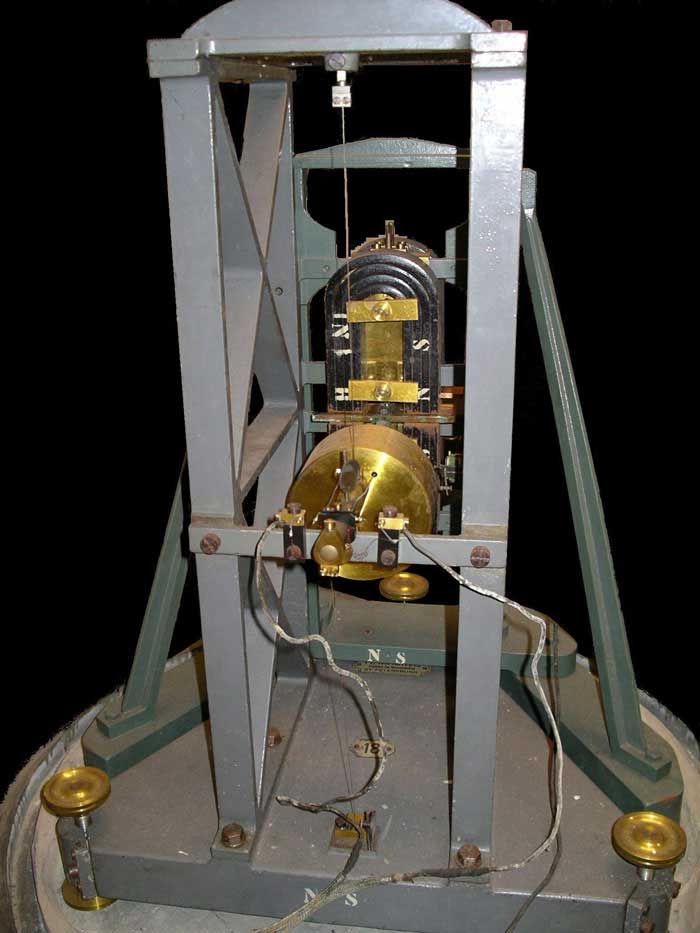
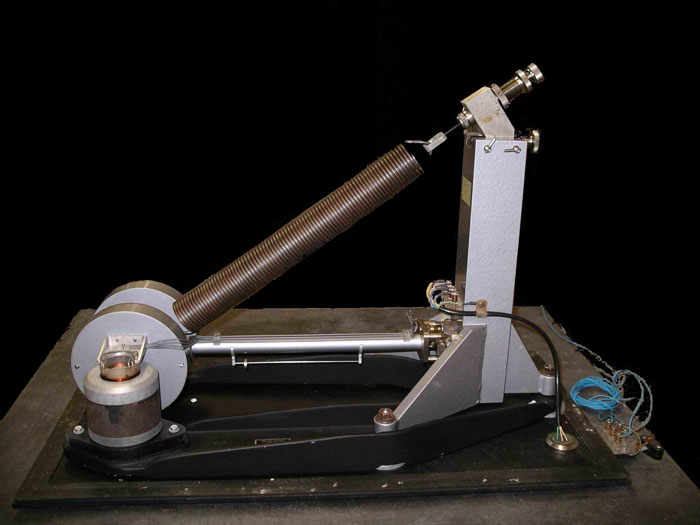
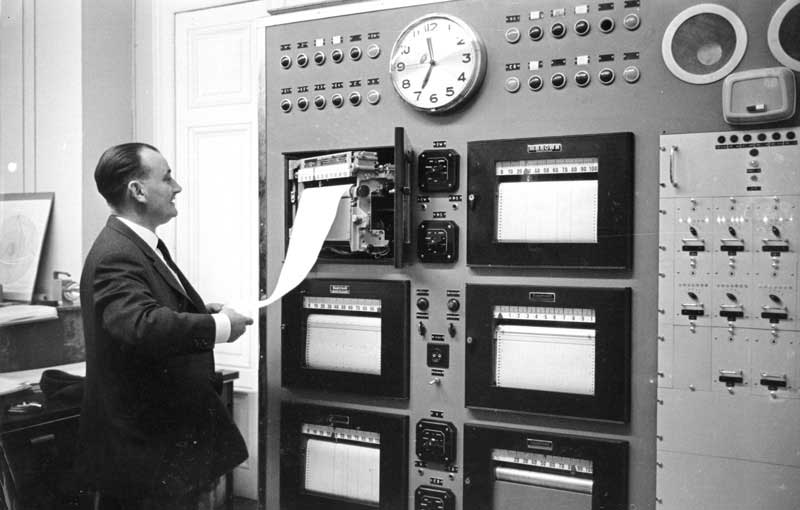
The Galitzine and Wiechert seismometers were decommissioned during the 1970s and replaced in 1973 by three long-period Sprengnether/Press-Ewing seismometers (figure 6). Their signals were recorded in parallel on analogue magnetic tape and on the paper recorders (figure 7). All these data were archived on microfilm, whose poor quality makes them hard to use for scientific purposes.
All the historical instruments except the heavy Bosch-Omori pendulums are still at the Observatory, together with most of the recording systems.
The digital era
In April 1985, with the modernisation of the seismic network that followed the 1983 Liège earthquake, the Uccle station received a vertical-component short-period Sprengnether S-10 seismometer. Its signal was recorded, with that of other stations of the network, both analogically on new paper recorders, which stayed in service until 1999, and digitally on magnetic tape. The Uccle station thus entered the era of digital seismology.
Keeping time
Over the years, seismologists also strove constantly to improve the timing of the recordings. In 1909 a new clock was installed, synchronised – first daily, then continuously from 1912 – with the Observatory’s Time Department. DCF receivers have been used since 1984, alongside GPS receivers since 1998.
| Year | Timing accuracy |
|---|---|
| 1909 | 1 s |
| 1912 | 0.1 s |
| Today (DCF) | a hundredth of a second |
| Today (GPS) | much better than a thousandth of a second |
A borehole seismometer
Standing on poorly consolidated sediments, the Uccle station is very sensitive to the vibrations of urban and industrial development, and over time the seismic measurements became more and more disturbed. In 1998, a borehole was therefore drilled to 140 m depth to place a seismometer directly on the bedrock, improving the signal-to-noise ratio by a factor of 10 to 30 depending on the frequency band (figure 8).
Finally, an accelerograph has been installed in the seismic cellar since 2003 to record strong ground motion.
The first stations outside Uccle (1958–1983)
Until 1958, Uccle was the only seismic station in Belgium, and there were very few stations in neighbouring countries until the 1960s. This explains the importance of the Uccle seismological archives, which foreign scientists still consult regularly.
In 1958, a seismic station was set up at the geophysical centre that the Royal Meteorological Institute (RMI) had just established in Dourbes (figure 9).
To provide reliable information on the seismicity of our regions, more seismic stations had to be installed in the country:
- Warmifontaine (1964–1970). The first of these stations was installed in the slate quarries of Warmifontaine, 150 m underground. It was equipped with a short-period vertical Sprengnether seismometer and two horizontal Sprengnether seismometers of intermediate natural period, and produced some remarkable recordings of Belgian earthquakes.
- Luxembourg, then Walferdange (since 1967). From 1967 to 1972, a seismic station operated in the casemates of the city of Luxembourg. Its three seismometers were of the so-called “Stuttgart” type, with an intermediate natural period and photo-galvanometric recording. In 1975 the station was moved to a former mine in Walferdange. Three seismic stations now operate in the Grand Duchy of Luxembourg.
- Gileppe dam (1968–1970). When the Gileppe dam was raised, the Ministry of Public Works asked the Observatory to monitor the blasts of the works. A station with a short-period Grenet seismograph operated there from October 1968 to April 1970.
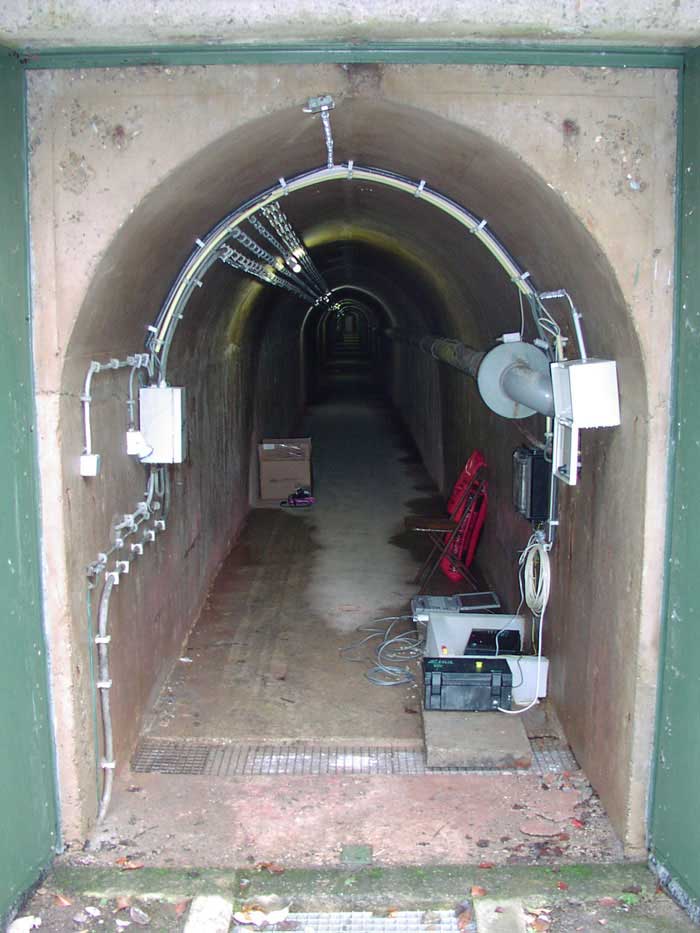
- Membach (since 1977). After these works, the Ministry of Public Works asked the Observatory to monitor the seismicity around the Gileppe and Eupen dams. A 130 m gallery was dug at Membach, where the seismic station has operated since 1977. It was first equipped with three short-period S-10 seismometers, replaced in 1985 by a Mark-Products L4-3D seismometer.
Towards a modern national network (since 1983)
In 1983, the Belgian seismic network was limited to the four stations of Uccle, Dourbes, Walferdange and Membach. Signals were recorded on paper only, and no telemetry link brought the measurements to Uccle. The destructive effects of the Liège earthquake of 8 November 1983 – 73.5 million euros of damage for an earthquake of moderate magnitude, ML = 5.0 – made the case for modernising and expanding the Belgian seismic network.
Major efforts followed, and by 1989 the network had grown to 15 stations, 6 of them linked to Uccle by telemetry, allowing fast data processing after an earthquake. Most instruments had meanwhile been fitted with digital recording systems, which greatly improved the dynamic range of the recorded signal and made computer processing and archiving of seismic data much easier.
Membach, a reference station
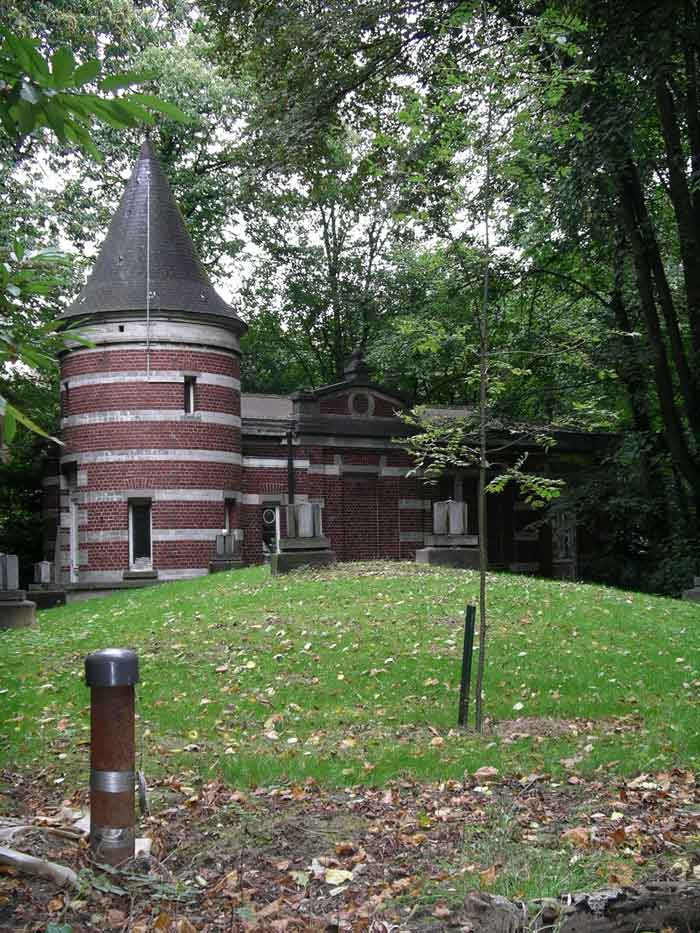
In the 1990s, the effort continued to improve and diversify the instruments. The Membach station, one of the best of the Belgian network, received particular attention (figure 10):
- Güralp and Wielandt-Streckeisen STS-1 broadband seismometers were added to the existing equipment;
- since 1995, a GWR superconducting relative gravimeter has been recording continuously;
- regular measurements with an FG5 absolute gravimeter make the station the reference point for gravity in Belgium;
- an accelerometer was installed in 2003.
Membach is thus one of the few places in the world able to measure ground motion over a wide frequency band, from 100 Hz to secular trends.
The network today
The seismic network has kept modernising. The acquisition systems have been renewed, and most stations are now linked to the ROB in Uccle by telemetry. The network is also gradually being extended, including in the north of the country, where the geology requires deep and costly boreholes through the sedimentary layers to place the seismometers on the bedrock.
The seismic network now has more than twenty stations. Alongside it, an accelerometric network, designed to measure strong ground motion during earthquakes, has been deployed in Belgium since 1999.
References
- VAN CAMP M. and CAMELBEECK T. (2004). Histoire des stations sismiques belges. De la station « Ernest Solvay » au réseau national de surveillance sismique. Ciel et Terre, 120(6).
- CAMELBEECK T. (1985). Some notes concerning the seismicity in Belgium. Magnitude scale. Detection capability of the Belgian seismic stations. In P. Melchior (ed.), Seismic Activity in Western Europe, Reidel.
- CAMELBEECK T. (1989). L’activité séismique actuelle (1985-1988) en Belgique. Comparaison avec les données de séismicité historique et instrumentale. Analyse séismotectonique. Annales de la Société géologique de Belgique, 112(2), 347–365.
- LECOCQ T., CAMELBEECK T., RAPAGNANI G. et al. (2013). Trente ans de surveillance sismique en Belgique. Ciel et Terre, 129(5), 105–109.